The Dancing Girl of Mohenjo-daro
Held at National Museum, New Delhi · New Delhi, India
Full explanation below in English. 简体中文 and 繁體中文 versions are also available from the language menu.
Why everyone wants to see it
Ten centimetres of bronze, 4,500 years old, standing with a confidence that leaps across the millennia.
The story
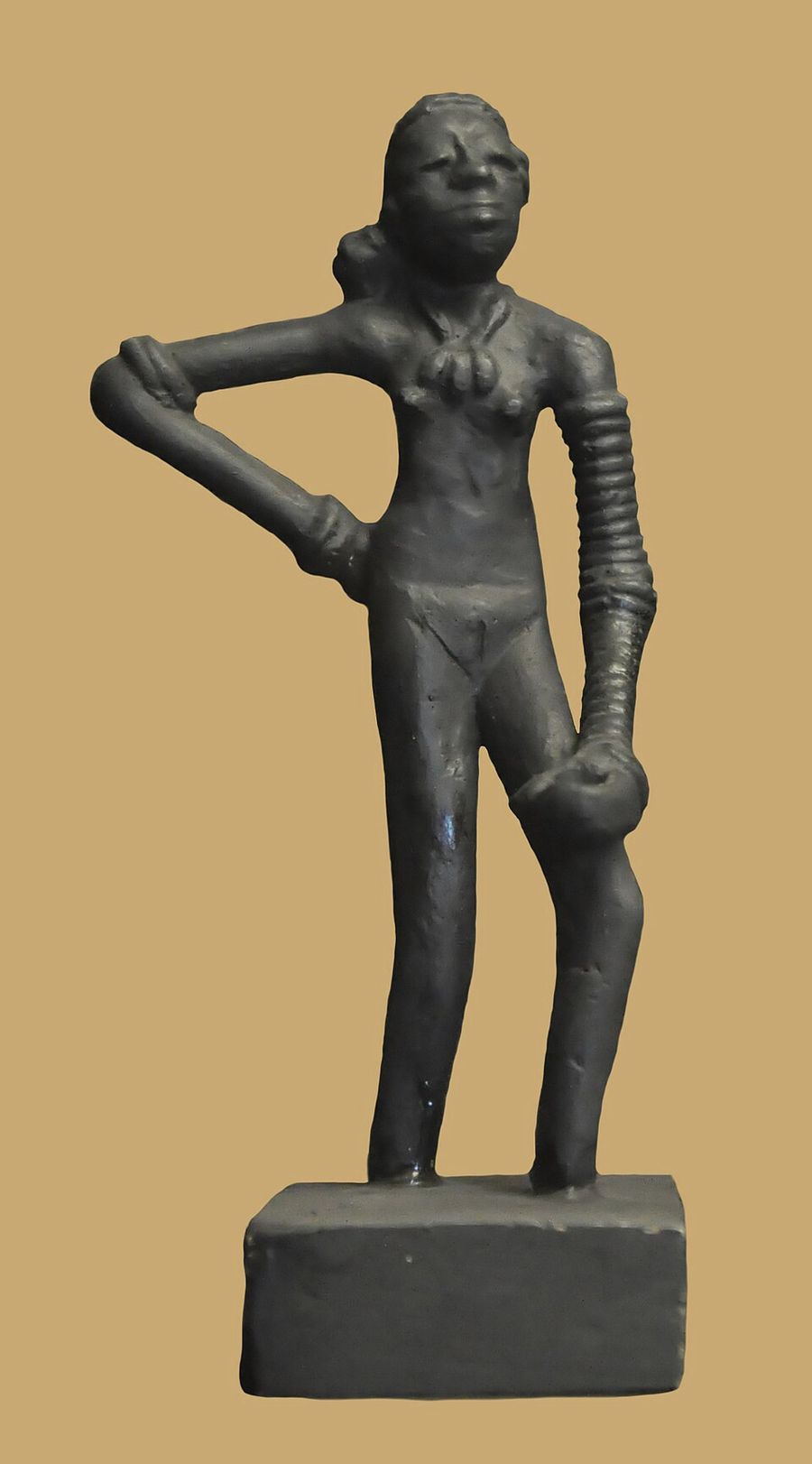
She is barely 10.5 centimetres tall, and she stops visitors in their tracks. Cast by the lost-wax method in Mohenjo-daro, the great planned city of the Indus Valley Civilisation, around 4,500 years ago, the 'Dancing Girl' stands in an attitude no one forgets: one hand on her hip, head tilted, utterly self-assured. Archaeologist John Marshall, whose teams excavated her in the 1920s, wrote that she showed a young woman 'with complete confidence in herself'. We do not know if she danced, who she was, or what her bangles and necklace meant — the Indus script remains undeciphered, and the civilisation that made her left no readable words. She is the National Museum of India's most famous small object: proof that personality can survive five thousand years in a palmful of bronze.
One wow fact
One arm is covered wrist-to-shoulder with bangles — twenty-eight of them — and she wears almost nothing else. Her casting quality rivals anything the ancient world produced, from a civilisation whose writing we still cannot read.
Information page — not the museum's official page. Museums can claim and enrich this profile free of charge.
Artsymus is a technology platform: we never buy, sell or hold artworks. Explanations are information from recorded open-access sources — not appraisals or professional advice — and a certificate check only confirms that a record matches; it never authenticates a work.
Artsymus is a technology platform. We never buy, sell or hold artworks — artists sell, collectors buy, we provide the technology.