Along the River During the Qingming Festival
Held at Palace Museum · Beijing, China
Full explanation below in English. 简体中文 and 繁體中文 versions are also available from the language menu.
Why everyone wants to see it
China's most famous painting: a 5.3-metre scroll that unrolls an entire city, street by street, life by life.
The story
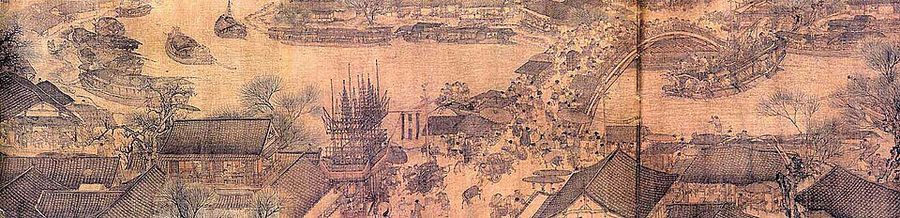
Around the early 1100s, the court painter Zhang Zeduan unrolled the busiest city on Earth — Kaifeng, capital of the Northern Song — into a single handscroll over five metres long. A handscroll is viewed the way a journey unfolds: unrolling section by section, you walk from quiet countryside into suburbs, across the great rainbow bridge over the Bian River, and into streets dense with shops, restaurants, porters and storytellers. Nothing like it survives from anywhere in the medieval world: a complete society, observed with wit and total recall. The original is so precious that the Palace Museum displays it only rarely, for a few weeks at a time, and queues stretch for hours. Between showings, celebrated copies and animated digital versions keep its streets alive for the millions who know it by heart.
One wow fact
More than 800 individual figures crowd the scroll — boatmen, donkey drivers, monks, officials, children — and at its climax a river boat lowers its mast in a panic to squeeze under a packed bridge.
Information page — not the museum's official page. Museums can claim and enrich this profile free of charge.
Artsymus is a technology platform: we never buy, sell or hold artworks. Explanations are information from recorded open-access sources — not appraisals or professional advice — and a certificate check only confirms that a record matches; it never authenticates a work.
Artsymus is a technology platform. We never buy, sell or hold artworks — artists sell, collectors buy, we provide the technology.