The Houmuwu Ding — the heaviest ancient bronze on Earth
Held at National Museum of China · Beijing, China
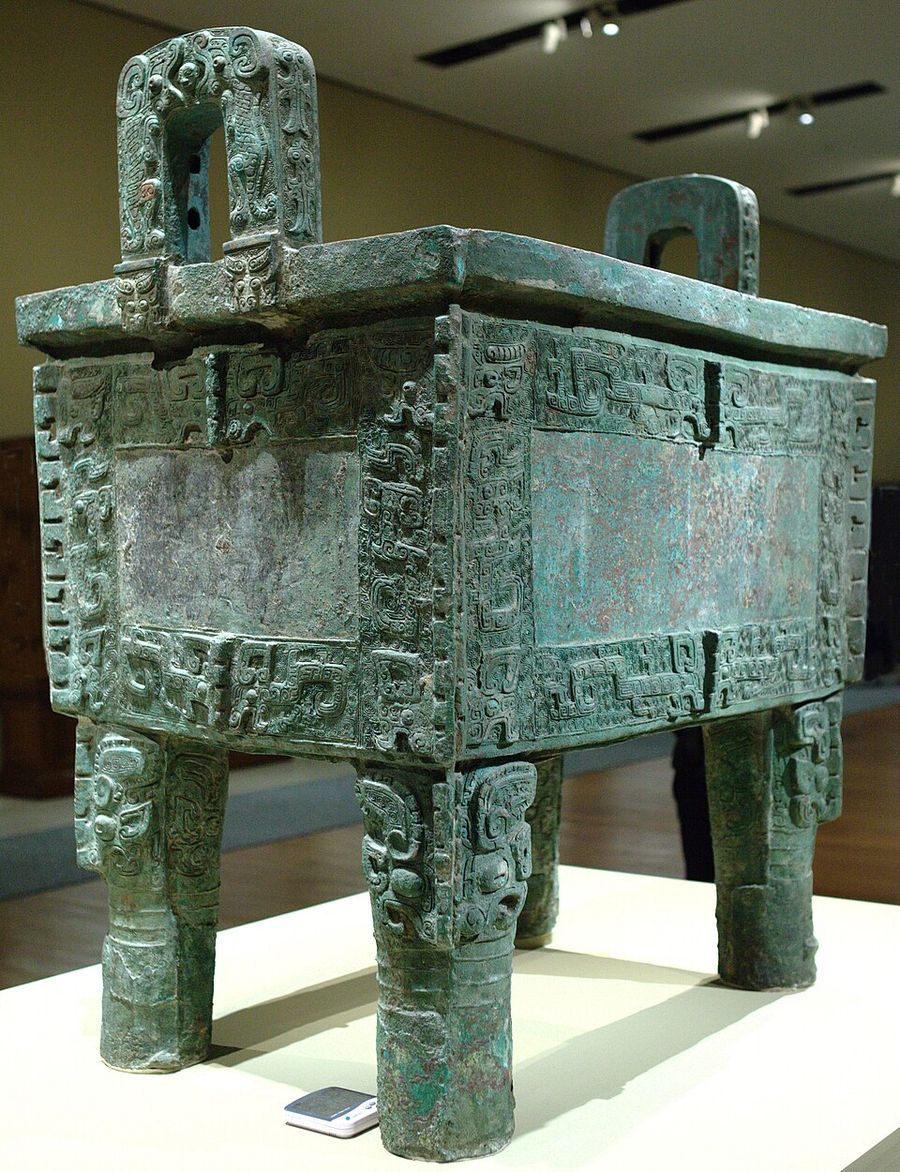
Full explanation below in English. 简体中文 and 繁體中文 versions are also available from the language menu.
Why everyone wants to see it
A bronze cauldron weighing 833 kilograms — cast more than 3,000 years ago for a king to honour his mother.
The story
A ding was the supreme ritual vessel of Bronze Age China: a cauldron for offering food to ancestors, and a symbol of royal power itself. This one, dug up in 1939 near Anyang, is in a class of its own — 133 cm tall and 832.84 kg of bronze, its belly decorated with taotie beast masks and its interior wall inscribed with three characters, 'Hou Mu Wu': a dedication from a Shang king to his mother, Queen Wu. Villagers who found it during wartime hid it from looters and invading troops, reburying it until it could reach safety; one of its ears was damaged in those years and later restored. To stand before it in the National Museum of China is to feel the sheer organisational power of the Shang state — a civilisation that could command this much metal, fire and skill for a single act of filial devotion.
One wow fact
Casting it required the metal of hundreds of crucibles poured in a single coordinated operation, by perhaps two or three hundred craftsmen working at once. It is still the heaviest ancient bronze vessel ever found.
Information page — not the museum's official page. Museums can claim and enrich this profile free of charge.
Artsymus is a technology platform: we never buy, sell or hold artworks. Explanations are information from recorded open-access sources — not appraisals or professional advice — and a certificate check only confirms that a record matches; it never authenticates a work.
Artsymus is a technology platform. We never buy, sell or hold artworks — artists sell, collectors buy, we provide the technology.