The Terracotta Army
Held at Emperor Qinshihuang's Mausoleum Site Museum · Xi'an, China
Full explanation below in English. 简体中文 and 繁體中文 versions are also available from the language menu.
Why everyone wants to see it
Eight thousand life-size soldiers, each with a different face, buried to guard an emperor for eternity.
The story
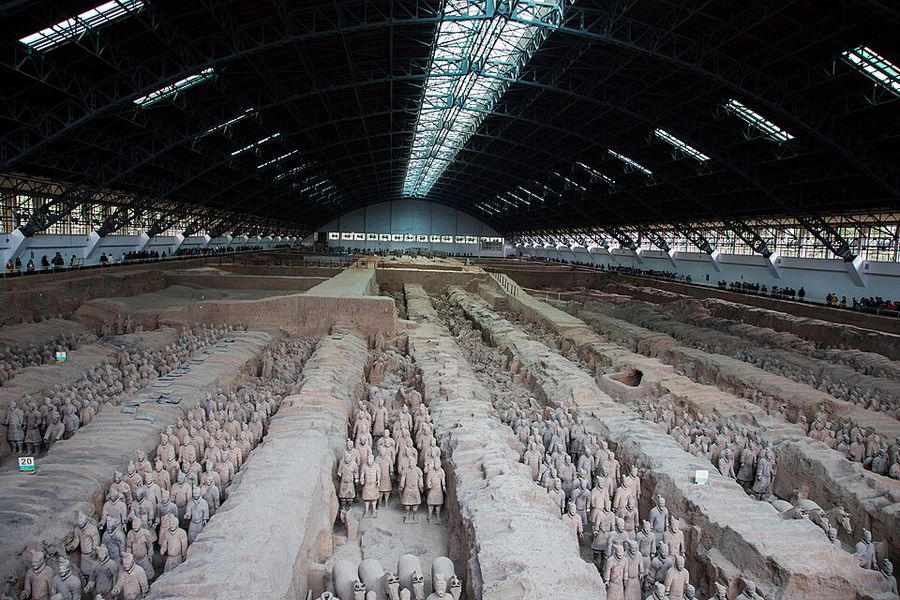
In 1974, farmers digging a well near Xi'an broke into one of the greatest archaeological finds of all time: an underground army of some 8,000 life-size terracotta soldiers, plus horses, chariots and weapons, standing in battle formation in vast pits. They were made around 210 BC for Qin Shi Huang, the first emperor to unite China, whose tomb mound still rises nearby, unopened. Every figure was assembled from moulded parts, then finished by hand — different faces, hairstyles, uniforms and ranks, from kneeling archers to generals. The army was meant to serve the emperor in the afterlife exactly as his real armies had on earth. Excavation continues today, pit by pit, and the main hall — a hangar of silent ranks under a vaulted roof — remains one of the most overwhelming sights in any museum on Earth.
One wow fact
The warriors were originally painted in bright colours that flake off within minutes of excavation. Their weapons were coated in chrome — a preservation technology Europe did not 'invent' until the 1930s.
Information page — not the museum's official page. Museums can claim and enrich this profile free of charge.
Artsymus is a technology platform: we never buy, sell or hold artworks. Explanations are information from recorded open-access sources — not appraisals or professional advice — and a certificate check only confirms that a record matches; it never authenticates a work.
Artsymus is a technology platform. We never buy, sell or hold artworks — artists sell, collectors buy, we provide the technology.