The Winged Victory of Samothrace
Held at Musée du Louvre · Paris, France
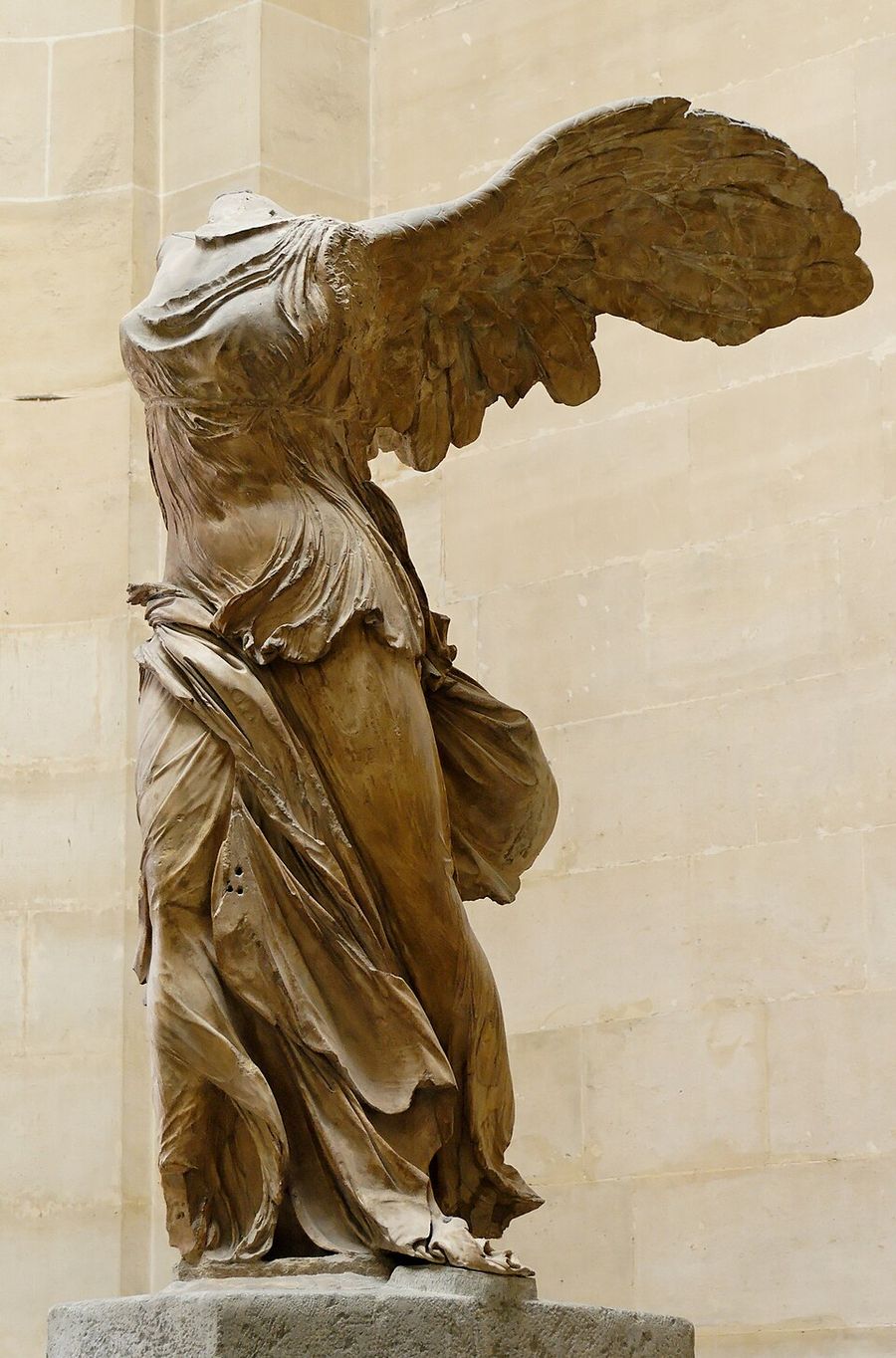
Full explanation below in English. 简体中文 and 繁體中文 versions are also available from the language menu.
Why everyone wants to see it
A goddess landing on a ship's prow into the sea wind — headless, yet the most alive statue of the ancient world.
The story
Nike, goddess of victory, comes in for a landing on the prow of a warship, wings still beating, her wet drapery whipped against her body by the wind of the Aegean. Carved around 200 BC, probably to celebrate a naval victory, she stood in the sanctuary of the Great Gods on Samothrace, in a fountain or theatre setting where real wind and water completed the illusion. A French diplomat-archaeologist found her shattered in 1863; her head and arms were never recovered, yet no statue feels less incomplete. In the Louvre she crowns the Daru staircase, and every visitor climbs toward her as sailors once climbed toward the sanctuary. Restorations have debated adding nothing at all: the fragments of a right wing, mirrored in plaster, gave her back her span. She is movement itself, frozen mid-gust.
One wow fact
She was found in more than a hundred fragments on a remote Greek island in 1863. The Louvre built its grand Daru staircase around her, and her silhouette later inspired the spirit of a certain famous car grille — and a swoosh-adjacent sense of speed everywhere.
More treasures at this museum
- Mona Lisa Musée du Louvre
- Venus de Milo Musée du Louvre
- Liberty Leading the People Musée du Louvre
Same culture · Greece & Rome
- Venus de Milo Musée du Louvre
- The Parthenon Sculptures British Museum
Information page — not the museum's official page. Museums can claim and enrich this profile free of charge.
Artsymus is a technology platform: we never buy, sell or hold artworks. Explanations are information from recorded open-access sources — not appraisals or professional advice — and a certificate check only confirms that a record matches; it never authenticates a work.
Artsymus is a technology platform. We never buy, sell or hold artworks — artists sell, collectors buy, we provide the technology.