The Garden of Earthly Delights
Held at Museo del Prado · Madrid, Spain
Full explanation below in English. 简体中文 and 繁體中文 versions are also available from the language menu.
Why everyone wants to see it
Paradise, a carnival of pleasure, and the strangest hell ever painted — a 500-year-old puzzle nobody has fully solved.
The story
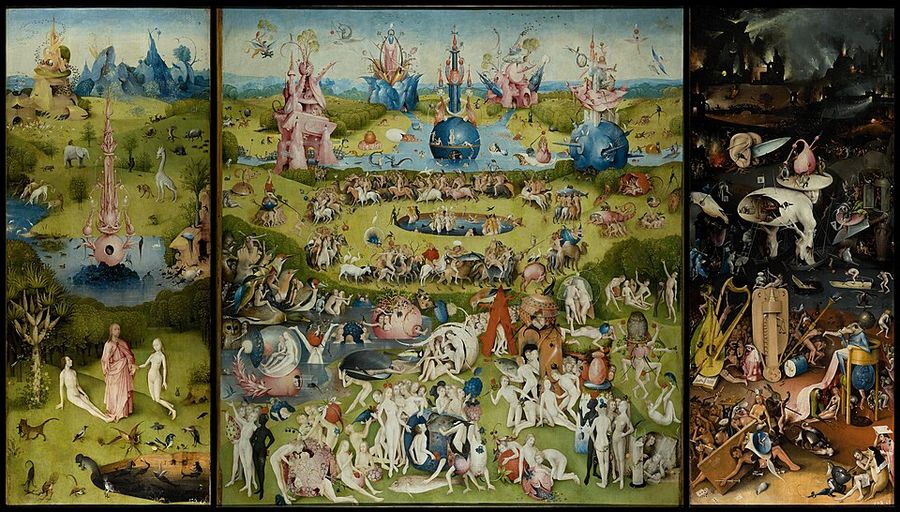
Open the shutters of this triptych and three worlds unfold. Left: Adam and Eve in a green paradise of improbable animals. Centre: a vast garden where hundreds of naked figures feast on giant strawberries, ride beasts in procession and sport inside glass bubbles — pleasure at full flood. Right: a black, burning hell of musical instruments turned into torture devices, ruled by a bird-headed prince. Hieronymus Bosch painted it around 1500 in the Netherlands, and scholars have argued ever since about whether the centre is a celebration, a warning, or a lost paradise of what might have been. Acquired by King Philip II of Spain, it has hung in the Prado since 1939, where visitors still stand for long minutes, hunting details: an owl here, a mermaid there, a man with flowers growing where flowers should not grow.
One wow fact
In the hell panel, a bird-monster devours sinners on a throne-like toilet, and a giant ear is pierced by a knife. One detail — sheet music painted on a sinner's backside — has been transcribed and recorded by modern musicians.
More treasures at this museum
- Las Meninas Museo del Prado
Same culture · Renaissance Europe
- Mona Lisa Musée du Louvre
- The Birth of Venus Uffizi Galleries
- David Galleria dell'Accademia
- The Sistine Chapel Ceiling Vatican Museums
- The School of Athens Vatican Museums
- The Arnolfini Portrait National Gallery
Information page — not the museum's official page. Museums can claim and enrich this profile free of charge.
Artsymus is a technology platform: we never buy, sell or hold artworks. Explanations are information from recorded open-access sources — not appraisals or professional advice — and a certificate check only confirms that a record matches; it never authenticates a work.
Artsymus is a technology platform. We never buy, sell or hold artworks — artists sell, collectors buy, we provide the technology.