Venus de Milo
Held at Musée du Louvre · Paris, France
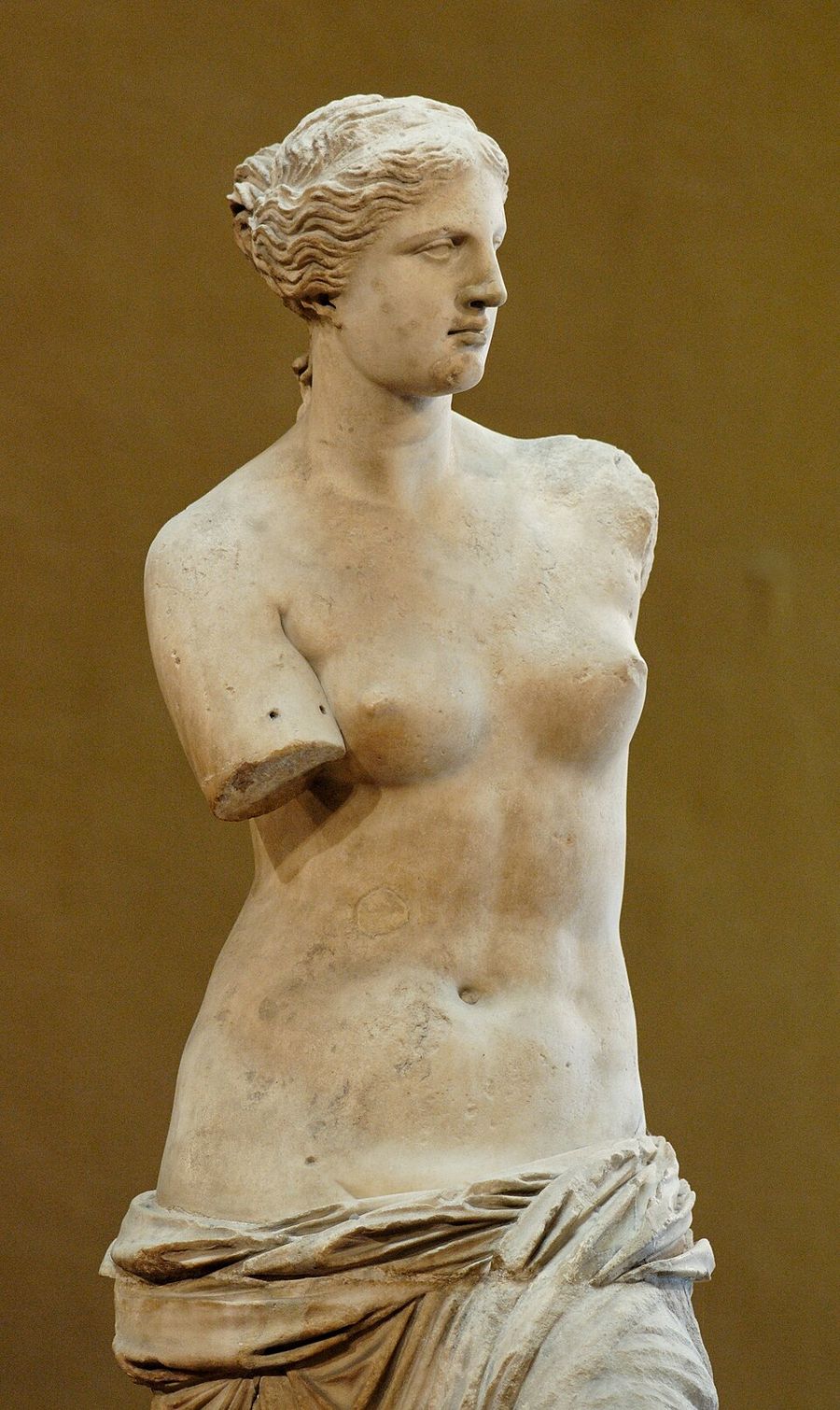
Why everyone wants to see it
The most famous armless statue in the world — her missing arms have been imagined a thousand ways.
The story
In 1820, on the Aegean island of Milos, a farmer digging in ancient ruins uncovered a marble goddess in two great pieces. Aphrodite — Venus to the Romans — carved in the Hellenistic age around 150 BC, she twists gently as her drapery slips from her hips, serene and unreachable. Rushed to Paris amid diplomatic scramble, she was presented to King Louis XVIII and installed in the Louvre, where curators quietly dropped the inscribed base that dated her — a later, less 'classical' date than they wanted. Her arms were never found attached; whether she held an apple, a shield, or a spindle, no one knows. That absence is her power: for two centuries artists, advertisers and dreamers have completed her in their minds. She presides over a Louvre gallery built around her alone.
One wow fact
She was found in pieces on the island of Milos in 1820 by a farmer. Fragments of an arm and a hand holding an apple were found nearby — the Louvre has always displayed her without them, and the mystery became the legend.
More treasures at this museum
- Mona Lisa Musée du Louvre
- The Winged Victory of Samothrace Musée du Louvre
- Liberty Leading the People Musée du Louvre
Same culture · Greece & Rome
- The Winged Victory of Samothrace Musée du Louvre
- The Parthenon Sculptures British Museum
Information page — not the museum's official page. Museums can claim and enrich this profile free of charge.
Artsymus is a technology platform: we never buy, sell or hold artworks. Explanations are information from recorded open-access sources — not appraisals or professional advice — and a certificate check only confirms that a record matches; it never authenticates a work.
Artsymus is a technology platform. We never buy, sell or hold artworks — artists sell, collectors buy, we provide the technology.