The Parthenon Sculptures
Held at British Museum · London, United Kingdom
Why everyone wants to see it
The marble heart of Athens' great temple — and the world's most famous argument about where treasure belongs.
The story
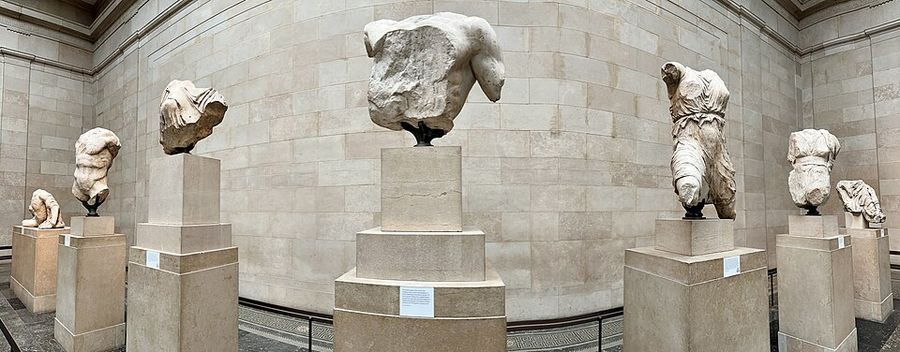
Between 447 and 432 BC, Athens crowned its Acropolis with the Parthenon, temple of Athena, and the sculptor Phidias filled it with marble storytelling: gods feuding on the pediments, centaurs battling on the metopes, and around the inner wall a 160-metre frieze of the city's own festival procession — horsemen, musicians, maidens, sacrificial animals, carved with a life that still startles. The temple survived as church and mosque until 1687, when a Venetian shell ignited the gunpowder stored inside and blew it apart. In the early 1800s Lord Elgin, British ambassador to the Ottomans, removed about half the surviving sculptures to London, where Parliament bought them for the British Museum in 1816. Greece has campaigned for their reunification for decades, and the purpose-built Acropolis Museum in Athens waits with the remainder. In London's Duveen Gallery they remain what they have been for two centuries: the benchmark of classical beauty, and the centre of the world's defining debate about cultural heritage.
One wow fact
The frieze ran 160 metres around the temple, showing Athens' great festival procession. The sculptures were originally painted in bright colours — the white-marble look the world admires is an accident of time.
More treasures at this museum
- The Rosetta Stone British Museum
- The Gebelein Mummy, known as “Ginger” British Museum
- The Papyrus of Ani — the Book of the Dead British Museum
- The Benin Bronzes British Museum
- Hoa Hakananai'a — the Easter Island Moai British Museum
- The Sutton Hoo Helmet British Museum
Same culture · Greece & Rome
- Venus de Milo Musée du Louvre
- The Winged Victory of Samothrace Musée du Louvre
Information page — not the museum's official page. Museums can claim and enrich this profile free of charge.
Artsymus is a technology platform: we never buy, sell or hold artworks. Explanations are information from recorded open-access sources — not appraisals or professional advice — and a certificate check only confirms that a record matches; it never authenticates a work.
Artsymus is a technology platform. We never buy, sell or hold artworks — artists sell, collectors buy, we provide the technology.